
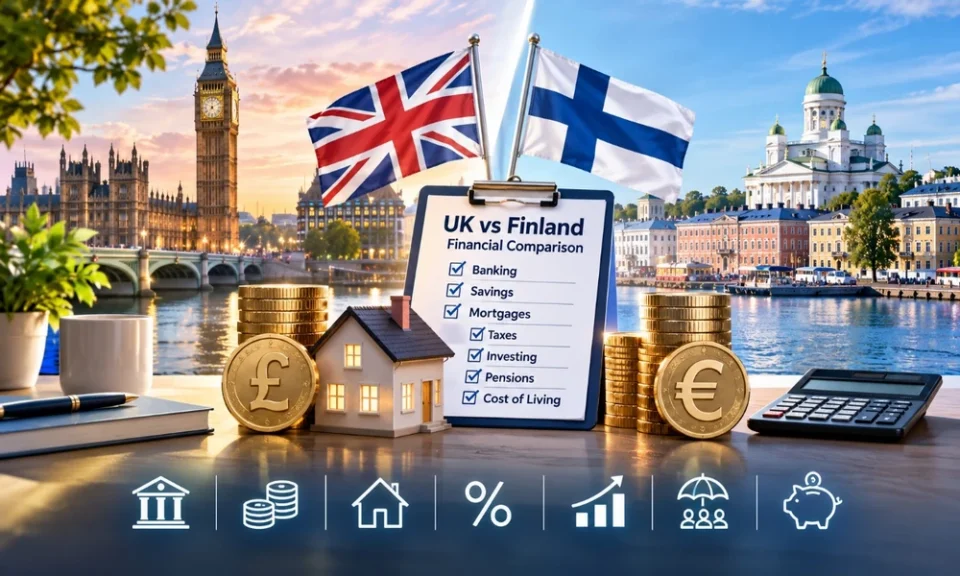
An independent guide to understanding the financial differences between the United Kingdom and Finland, including everyday banking, property finance, taxation, pensions and investment accounts.
The United Kingdom and Finland are both highly developed European economies with established banking systems, sophisticated financial markets and extensive consumer financial services.
However, the way individuals save, borrow, invest, pay taxes and plan for retirement can differ considerably between the two countries.
For British nationals moving to Finland, Finnish citizens relocating to the UK, internationally mobile professionals and cross-border investors, these differences can have a significant effect on household finances.
The most important financial questions are not simply whether salaries are higher in one country or which country has lower taxes.
A meaningful comparison should also consider:
- Banking costs and account accessibility.
- Savings interest and deposit protection.
- Mortgage structures and borrowing requirements.
- Income taxation and social contributions.
- Investment account rules and taxation.
- Pension arrangements and retirement planning.
- Insurance and household protection.
- Currency exchange costs.
- Housing and living expenses.
- Cross-border financial obligations.
This guide explains the key differences between personal finance in the UK and Finland and provides a practical framework for comparing financial products across both markets.
For Finland-specific financial product research, visit WiTRaha – Finnish Financial Comparisons.
For banking, borrowing, savings and investments in the United Kingdom, explore WiT Money – UK Financial Product Comparisons.
UK vs Finland: Financial Comparison at a Glance
Although both countries offer modern financial services, their currencies, regulatory structures and consumer financial arrangements differ.
| Financial Category | United Kingdom | Finland |
| Currency | British pound (GBP) | Euro (EUR) |
| Central banking framework | Bank of England | European Central Bank and Eurosystem |
| Everyday banking | Current accounts, digital banks and building societies | Current accounts, digital banking and cooperative banks |
| Savings products | Easy-access accounts, fixed-term accounts and Cash ISAs | Savings accounts and fixed-term deposits |
| Deposit protection | Generally £120,000 per eligible person, per authorised firm | Generally €100,000 per depositor, per relevant bank |
| Mortgage interest | Fixed-rate deals and variable or tracker products | Variable Euribor-linked mortgages are common; fixed options also exist |
| Property ownership | Freehold and leasehold arrangements, with regional differences | Direct real estate and housing-company share ownership |
| Tax-advantaged investing | ISAs, pensions and other eligible arrangements | Equity savings accounts and other pension or investment structures |
| Main investment currency | GBP | EUR |
| Personal taxation | UK tax system, with some differences across constituent nations | Finnish national, municipal and other applicable taxation |
| State retirement provision | UK State Pension | Finnish earnings-related and applicable national pension arrangements |
| Public healthcare | NHS systems across UK nations | Finnish public healthcare and social insurance arrangements |
| Main cross-border consideration | GBP/EUR currency and residence-related obligations | EUR/GBP currency and residence-related obligations |
This comparison is intended as a general overview. Eligibility, taxation and financial product conditions depend on individual circumstances and the applicable jurisdiction.
1. Banking in the UK vs Finland
One of the first differences an individual may notice when moving between the UK and Finland is how everyday banking works.
Both countries have modern digital banking infrastructure, but they differ in account structures, authentication requirements, customer benefits and banking traditions.
Banking in the United Kingdom
The UK banking market includes major high-street banks, building societies, specialist savings institutions and digital banking providers.
Examples of established UK retail banking brands include:
- Barclays.
- HSBC.
- Lloyds.
- NatWest.
- Nationwide.
- Santander UK.
- Monzo.
- Starling Bank.
UK current accounts may provide:
- Salary payments.
- Direct debits.
- Debit cards.
- Mobile banking.
- Arranged overdrafts, subject to approval.
- Cashback or rewards.
- Current-account switching services.
Many standard current accounts have no monthly maintenance fee, although packaged accounts and additional services may carry charges.
The most suitable account depends on eligibility, transaction needs, branch preferences and overseas payment costs.
Banking in Finland
Finland’s banking market includes established institutions such as:
- Nordea.
- OP Financial Group.
- Danske Bank.
- S-Bank.
- Aktia.
- Savings Banks and other local banking providers.
Finnish banks commonly offer current accounts, debit cards, payment services, savings accounts, loans and investment products.
One particularly important feature of Finnish banking is the widespread use of strong electronic identification.
Eligible online banking credentials can support identification for various public and private digital services.
However, having a bank account does not automatically guarantee access to credentials suitable for external electronic identification.
Key differences
| Feature | UK Banking | Finnish Banking |
| Currency | GBP | EUR |
| Free standard current accounts | Commonly available | Depends on provider and customer conditions |
| Digital banking | Widely available | Widely available |
| Branch banking | Available, but branch networks vary | Available, with local availability varying |
| Strong digital identification | Separate identity and authentication arrangements | Bank credentials play an important role in digital identification |
| Cooperative banking | Building societies and mutual institutions | Cooperative banking is an important part of the market |
| International payments | May involve GBP/EUR conversion | May involve EUR/GBP conversion |
Which is better?
Neither system is universally better.
UK banking may appeal to customers seeking a wide range of current-account features, switching incentives and digital banking options.
Finnish banking can provide strong integration with domestic payment services and the country’s digital identification environment.
For a comprehensive review of Finnish financial products, explore WiTRaha’s independent finance comparison platform.
For UK account research, visit WiT Money’s banking and financial comparison resources.
2. Savings Accounts: UK vs Finland
Savings products are another important area of comparison.
Both countries offer deposit accounts, but interest-rate structures, available tax arrangements and account conditions differ.
Savings accounts in the UK
Common UK savings products include:
Easy-access savings accounts
Allow withdrawals subject to the product terms.
Fixed-rate savings accounts
Offer an agreed rate for a specified period, often with restrictions on withdrawals.
Notice accounts
Require advance notice before withdrawals.
Regular savings accounts
May reward recurring deposits, subject to contribution and withdrawal limits.
Cash Individual Savings Accounts (ISAs)
Eligible UK savers can earn interest within a tax-advantaged account, subject to the applicable ISA rules.
A Cash ISA is not automatically the highest-interest option. The rate, access restrictions and tax circumstances should be compared.
Savings accounts in Finland
Common Finnish savings products include:
Savings accounts – Säästötili
Deposit accounts with rates and withdrawal conditions set by the provider.
Fixed-term deposits – Määräaikaistalletus
Deposits held for an agreed term, generally with specified interest and access conditions.
Other deposit products
Some banks offer relationship-based or tiered savings products.
Unlike the UK, Finland does not have a direct equivalent of the Cash ISA operating under the same tax-free interest framework.
The tax treatment of savings interest must therefore be evaluated under Finnish rules.
Illustrative savings example
Suppose two savers each hold the equivalent of €20,000.
Assume:
- Savings Account A pays 3% annually.
- Savings Account B pays 2% annually.
Before tax and charges:
| Savings Rate | Illustrative Annual Interest |
| 2.0% | €400 |
| 3.0% | €600 |
The difference is €200 annually.
However, a higher advertised rate does not necessarily produce the best net outcome.
Consider:
- Tax treatment.
- Withdrawal restrictions.
- Currency conversion.
- Account eligibility.
- Deposit protection.
- Rate guarantees.
- Introductory bonuses.
When comparing savings in different countries, also consider whether the funds will ultimately be spent in GBP or EUR.
3. Deposit Protection: UK vs Finland
Deposit protection is important when deciding where to hold savings.
UK deposit protection
As of October 2026, the standard UK Financial Services Compensation Scheme deposit protection limit is generally:
£120,000 per eligible person, per authorised firm.
This limit increased from £85,000 in December 2025.
Different banking brands may share an underlying banking authorisation, meaning eligible balances held across those brands may share a protection limit.
Additional protection can apply to certain qualifying temporary high balances.
Finnish deposit protection
Eligible deposits in Finnish banks are generally covered up to:
€100,000 per depositor, per relevant bank.
Applicable scheme rules determine the legal institution, qualifying deposit types and treatment of exceptional circumstances.
Which country offers better protection?
A direct comparison of £120,000 and €100,000 is incomplete because they are expressed in different currencies.
More importantly, protection depends on the legal institution and the relevant scheme.
An account held with an international financial provider may not fall under the deposit protection rules customers expect from its brand name.
Before transferring substantial balances, confirm which legal entity actually holds the deposit.
4. Mortgages in the UK vs Finland
Mortgage financing is one of the most significant differences between the two financial systems.
Both markets offer residential property loans, but interest structures, property ownership arrangements and transaction costs differ.
UK mortgage market
UK mortgage borrowers can encounter:
- Fixed-rate mortgages.
- Tracker mortgages.
- Other variable-rate arrangements.
- First-time buyer products.
- Buy-to-let mortgages.
- Remortgaging products.
Fixed-rate mortgage deals are common.
However, a fixed rate may apply for only part of the mortgage term.
When an initial fixed period ends, the borrower may need to choose another product or move onto a contractual variable rate.
Early repayment charges may apply under certain arrangements.
Finnish mortgage market
Finnish residential mortgages commonly use variable rates linked to Euribor.
A typical structure is:
Mortgage Interest Rate = Euribor Reference Rate + Bank Margin
For example:
- Illustrative Euribor: 2.5%.
- Bank margin: 0.7%.
- Total interest rate: 3.2%.
Actual pricing depends on the lender, borrower and loan agreement.
Fixed-rate and interest-protection alternatives may also be available.
UK vs Finland mortgage comparison
| Feature | United Kingdom | Finland |
| Main loan currency | GBP | EUR |
| Common rate structure | Fixed initial deals and variable options | Euribor-linked variable rates |
| Rate reset | Depends on mortgage product | Depends on selected reference-rate period |
| Property security | Relevant UK property rights and mortgage security | Finnish property or housing-company share security |
| Deposit | Depends on product, lender and borrower | Subject to loan-cap rules and lender underwriting |
| Refinancing | Remortgaging and product switching are common | Renegotiation and refinancing arrangements vary |
| Purchase taxes | Depend on UK nation and buyer circumstances | Finnish transfer tax rules |
| Main financial risk | Rate increases and affordability | Euribor changes and affordability |
A mortgage payment comparison
Consider a hypothetical €200,000-equivalent repayment mortgage over 25 years.
| Interest Rate | Approximate Monthly Payment |
| 3% | €948 |
| 4% | €1,056 |
| 5% | €1,169 |
| 6% | €1,289 |
These figures assume a constant nominal annual interest rate and monthly amortisation, excluding fees.
The illustration shows the effect of interest rates, not actual mortgage pricing in either country.
An important Finnish property distinction
Finnish apartments are often owned through housing-company shares.
A property listing may distinguish:
- Selling price.
- Debt-free price.
- Allocated housing-company loan.
- Monthly maintenance charges.
- Housing-company financing charges.
Buyers unfamiliar with Finnish property arrangements should evaluate the debt-free purchase price and all associated ongoing obligations.
Property taxes
In the UK, property transaction taxes differ between England and Northern Ireland, Scotland, and Wales.
In Finland, applicable transfer tax rules distinguish transactions involving housing-company shares from direct real estate ownership.
Therefore, a simple comparison of advertised purchase prices does not necessarily capture the full cost of ownership.
For Finnish mortgage and borrowing research, explore WiTRaha’s financial comparison resources.
For UK mortgages and property finance, visit WiT Money.
5. Income Tax: UK vs Finland
Taxation is one of the most frequently researched differences between the UK and Finland.
However, comparisons based on a single headline income-tax rate can be misleading.
UK income taxation
The UK has a personal income tax system that uses tax bands and allowances.
Income tax treatment can differ across UK nations, particularly for Scottish non-savings, non-dividend income.
Employees may also pay National Insurance contributions.
The precise amount payable depends on:
- Taxable income.
- Applicable allowances.
- Employment arrangements.
- Residence and tax status.
- Income type.
- Other individual circumstances.
Finnish income taxation
Finland also uses progressive taxation, alongside other applicable taxes and social contributions.
Depending on circumstances, an individual’s employment income may be affected by:
- National income taxation.
- Municipal income taxation.
- Applicable church tax.
- Pension contributions.
- Unemployment insurance contributions.
- Other relevant statutory deductions.
The tax treatment can also differ between earned income and capital income.
Why headline tax rates are misleading
Consider two employees each earning the equivalent of €60,000 annually.
Their actual take-home pay cannot be established from gross salary alone.
A meaningful comparison would require:
- Exact tax year.
- Residence status.
- Employment location.
- Country and region within the UK.
- Pension contributions.
- Social insurance arrangements.
- Relevant deductions.
- Household circumstances.
A person with a lower headline tax rate may still experience a different overall financial outcome because of housing costs, healthcare arrangements, pension contributions and other expenses.
Which country has lower taxes?
There is no universal answer for every income level and household type.
The correct approach is to compare net disposable income under the relevant tax rules and then account for living costs and public-service arrangements.
Tax residency must be assessed carefully when working or living in both countries.
6. Investing in the UK vs Finland
Both countries provide access to international financial markets.
Investors can research products such as:
- Individual shares.
- Exchange-traded funds.
- Investment funds.
- Bonds.
- Pension investments.
- Other eligible financial instruments.
However, investment account structures and tax rules differ.
Investing in the UK
UK investors may have access to:
Stocks and Shares ISA
A tax-advantaged investment account for eligible individuals, subject to applicable subscription and residency rules.
General Investment Account
An investment account without the ISA’s tax shelter.
Self-Invested Personal Pension (SIPP)
A personal pension structure with specific tax and access rules.
Workplace Pension
An employment-related retirement savings arrangement.
Not all brokers offer every account type, and eligibility depends on individual circumstances.
Investing in Finland
Finnish investors commonly encounter:
Osakesäästötili – Equity Savings Account
A specialised account for eligible share investments, with taxation generally deferred until qualifying withdrawals.
Its product eligibility, deposit limits and withdrawal rules differ significantly from a UK ISA.
Arvo-osuustili – Book-Entry Securities Account
A commonly used account structure for holding eligible securities.
Investment Funds and ETFs
Available through Finnish and eligible international investment platforms.
UK ISA vs Finnish Equity Savings Account
| Feature | UK Stocks and Shares ISA | Finnish Equity Savings Account |
| Primary purpose | Tax-advantaged investing | Tax-deferred eligible share investing |
| Eligible investments | Broad range of permitted investment products | Primarily qualifying shares |
| Contribution rules | Annual ISA subscription rules | Separate statutory cash deposit limit |
| Tax treatment | Qualifying income and gains generally sheltered within ISA rules | Tax generally deferred until withdrawals, then applicable taxable return calculated |
| Access | Withdrawals subject to account/product rules | Withdrawals permitted, with relevant tax treatment |
| Eligibility | UK ISA eligibility requirements | Finnish statutory and provider eligibility requirements |
Important: A Finnish equity savings account is not simply Finland’s version of a UK Stocks and Shares ISA.
Their investment eligibility and taxation differ.
Investment fees
Investors in either country should compare:
- Trading commissions.
- Platform fees.
- Custody charges.
- Fund expense ratios.
- Currency conversion fees.
- Account transfer charges.
- Applicable taxes.
For Finnish brokers, investment platforms and account comparisons, explore WiTRaha.
For UK investing accounts and investment platform research, visit WiT Money.
7. Pensions and Retirement: UK vs Finland
Retirement systems are another area where differences extend beyond investment returns.
UK pensions
The UK retirement framework includes:
- State Pension.
- Workplace pensions.
- Personal pensions.
- Defined benefit schemes.
- Defined contribution schemes.
Depending on eligibility, workplace pension arrangements may involve employee and employer contributions.
Tax rules and minimum pension access ages are important considerations.
Finnish pensions
Finland’s pension arrangements include:
- Earnings-related pensions.
- Applicable national pension provisions.
- Certain other pension benefits.
- Voluntary retirement savings arrangements.
Earnings-related pension entitlement generally builds through eligible employment or self-employment under Finnish rules.
Cross-border pension considerations
Someone who has worked in both countries should examine:
- Pension entitlements earned in each jurisdiction.
- Social security coordination.
- Retirement ages.
- Contribution histories.
- Currency of pension payments.
- Tax treatment after relocation.
- Beneficiary arrangements.
Pension entitlements are not automatically lost simply because someone moves abroad, but payment rules, taxation and administrative requirements can differ.
Before transferring pension assets across borders, obtain appropriate specialist guidance.
8. Insurance in the UK vs Finland
Insurance is an essential part of financial planning in both countries.
However, the products and local requirements differ.
UK insurance
Common products include:
- Motor insurance.
- Home insurance.
- Travel insurance.
- Life insurance.
- Income protection.
- Critical illness cover.
- Business insurance.
Motor insurance is generally a legal requirement for vehicles used on public roads, subject to applicable rules and exemptions.
Finnish insurance
Common products include:
- Motor insurance.
- Home and contents insurance.
- Travel insurance.
- Life insurance.
- Personal accident cover.
- Business insurance.
Mandatory motor liability insurance is also an important part of Finland’s vehicle insurance framework.
What should you compare?
| Factor | Why It Matters |
| Coverage | Determines the risks insured |
| Excess or deductible | Determines the amount paid by the policyholder |
| Exclusions | Identifies circumstances not covered |
| Claims process | Affects practical usability |
| Territorial limits | Particularly relevant for international travel |
| Policy limits | Determine maximum coverage |
| Premium | Must be considered alongside benefits and exclusions |
A cheaper insurance policy is not automatically the better policy if it excludes important risks.
9. Healthcare Costs and Financial Protection
Healthcare arrangements affect household budgets in both countries.
United Kingdom
The UK has publicly funded NHS systems, although administration and access differ across its constituent nations.
Eligibility for particular services and charges may depend on residency, immigration status and the relevant NHS framework.
Private health insurance is also available.
Finland
Finland has a public healthcare system supported through taxation and other funding arrangements.
Residents may have access to public healthcare services subject to eligibility, applicable client fees and local arrangements.
Occupational healthcare can also play an important role for employees.
Private medical services and insurance are available.
The financial difference
When comparing salaries and taxes, consider:
- Access to public healthcare.
- Patient charges where applicable.
- Employer-provided healthcare.
- Private insurance costs.
- Prescription costs.
- Family healthcare requirements.
The relevant question is not simply whether one system is free and the other is paid.
Both have eligibility rules, costs and service arrangements that should be assessed individually.
10. Cost of Living: UK vs Finland
A meaningful financial comparison should include the cost of living.
Major household expenses may include:
- Housing.
- Electricity and heating.
- Groceries.
- Transport.
- Childcare.
- Insurance.
- Communications.
- Healthcare-related expenses.
- Savings and retirement contributions.
Housing
Housing expenses vary significantly by location.
London cannot be fairly compared with a small Finnish town, just as Helsinki should not be treated as representative of every Finnish municipality.
A better comparison might examine:
- London versus Helsinki.
- Manchester versus Tampere.
- Edinburgh versus Turku.
Even then, housing size, household needs and commuting patterns matter.
Transport
Transport costs depend on whether the household uses public transport, owns a car or relies on regional travel.
Energy
Heating requirements and property energy efficiency can significantly influence Finnish household expenses.
UK household energy costs also depend on tariffs, property characteristics and heating arrangements.
Groceries
The cost of a comparable basket may differ, but consumer choices, location and retailers affect the outcome.
A better affordability measure
Instead of comparing gross salaries, calculate:
Disposable Income After Essential Expenses = Net Household Income − Essential Household Costs.
That produces a more meaningful starting point for comparing financial circumstances.
11. Currency Exchange: GBP vs EUR
One of the most important differences between the UK and Finland is their currency.
The UK uses the British pound.
Finland uses the euro.
This introduces currency risk for individuals moving money, earning income or holding financial assets between the countries.
Example: Transferring savings from the UK to Finland
Suppose a person wants to convert £50,000 into euros.
The total cost can include:
- Foreign exchange spread.
- Transfer fee.
- Receiving bank charges.
- Exchange-rate movements.
Even a 1% exchange-rate cost represents:
£500 on a £50,000 conversion.
This example measures an illustrative percentage cost in pounds, not the final euro amount received.
Currency risk after relocation
Currency exposure can arise when:
- Salary is paid in GBP but expenses are in EUR.
- Pension income is paid in GBP while living in Finland.
- Investments are denominated in foreign currencies.
- Property is financed in a currency different from household income.
- Family support payments cross borders regularly.
International transfers should be compared using the final recipient amount, not just the advertised transfer fee.
12. Moving from the UK to Finland: Financial Checklist
Relocating from Britain to Finland involves several practical financial tasks.
Before moving
- Review UK bank account residency conditions.
- Confirm whether investment accounts can remain open.
- Check pension and retirement arrangements.
- Prepare evidence of income and savings.
- Review outstanding mortgages, loans and credit commitments.
- Understand currency conversion costs.
- Investigate relevant Finnish banking options.
After arriving in Finland
- Complete applicable residence and registration procedures.
- Investigate Finnish banking and electronic identification.
- Review tax residence and social insurance obligations.
- Arrange appropriate insurance.
- Understand housing costs and property ownership structures.
- Review savings and investment account eligibility.
- Update relevant institutions about the change of residence.
For comparing financial products available in Finland, explore WiTRaha – Banking, Saving, Borrowing and Investing in Finland.
13. Moving from Finland to the UK: Financial Checklist
Finnish residents moving to the United Kingdom should examine many of the same issues, but the banking and tax systems differ.
Before moving
- Confirm whether Finnish bank accounts can remain open.
- Review Finnish investment account restrictions.
- Assess Finnish pension entitlements.
- Consider potential tax residency changes.
- Review foreign exchange costs.
- Investigate UK employment and payroll arrangements.
- Check outstanding Finnish mortgage and property obligations.
After arriving in the UK
- Establish eligibility for UK banking services.
- Review National Insurance and taxation requirements.
- Understand workplace pension arrangements.
- Compare savings and investment accounts.
- Review insurance requirements.
- Investigate relevant mortgage options where needed.
- Update existing financial institutions about residency changes.
For UK financial products, savings accounts, investment platforms and borrowing comparisons, explore WiT Money – UK Financial Comparisons.
14. UK vs Finland for Entrepreneurs and Small Businesses
The financial differences between the two countries also affect business owners.
Both markets provide access to:
- Business bank accounts.
- Business loans.
- Overdrafts and revolving credit.
- Asset finance.
- Invoice finance.
- Leasing.
- Business insurance.
- Investment and funding services.
However, corporate taxation, legal structures, registration procedures and financing conditions differ.
UK business finance
Entrepreneurs may consider:
- Limited companies.
- Business current accounts.
- Business credit cards.
- Commercial loans.
- Asset finance.
- Invoice finance.
- Alternative business funding.
Finnish business finance
Finnish businesses may use:
- Limited liability companies.
- Business bank accounts.
- SME loans.
- Leasing.
- Invoice finance.
- Public and private financing mechanisms.
- Other working capital products.
International business considerations
Business owners operating in both countries should evaluate:
- Corporate tax residence.
- Permanent establishment risk.
- VAT obligations.
- Currency exchange.
- Payroll.
- Business banking access.
- Financing costs.
- Regulatory requirements.
The most suitable business structure depends on the actual commercial activities and relevant legal rules.
15. Which Country Is Better for Saving and Investing?
There is no universally correct answer.
The financial advantages of living in the UK or Finland depend on:
- Income.
- Tax residence.
- Available investment accounts.
- Savings rates.
- Currency needs.
- Household expenses.
- Retirement arrangements.
- Risk tolerance.
- Investment time horizon.
The UK may offer advantages for eligible savers seeking:
- Cash ISAs.
- Stocks and Shares ISAs.
- A broad range of savings account structures.
- Pension wrappers.
- UK-specific banking and investment services.
Finland may offer advantages for eligible residents seeking:
- Euro-denominated financial arrangements.
- Finnish equity savings accounts.
- Domestic banking and digital identification integration.
- Finnish retirement and financial services.
- Products tailored to Finnish tax and residency circumstances.
However, an account’s tax advantages cannot be evaluated independently of the account holder’s tax residence and eligibility.
Someone moving between countries may face restrictions on making new contributions or accessing products, even when existing accounts can be retained.
16. Common Financial Mistakes When Moving Between the UK and Finland
Comparing gross salaries rather than disposable income
Taxes and essential living costs affect the actual financial outcome.
Assuming investment account benefits transfer internationally
UK ISAs and Finnish equity savings accounts have different rules.
Ignoring currency exchange expenses
Large transfers can incur material costs even when a service advertises low fixed fees.
Assuming every bank accepts non-residents
Residency and identification requirements vary.
Forgetting pension arrangements
Employment in multiple countries can create separate pension entitlements and administrative obligations.
Comparing mortgage rates without examining structure
Fixed-rate UK mortgage periods and Euribor-linked Finnish mortgages behave differently.
Underestimating property purchase expenses
Taxes, registration fees and property-specific liabilities can affect affordability.
Confusing deposit protection limits
Account protection depends on the legal institution and scheme, not just the brand name.
Ignoring tax residency transitions
Moving country can change financial reporting and tax obligations.
Frequently Asked Questions
Is Finland financially better than the UK?
Neither country is universally better. The answer depends on income, location, taxes, household expenses, financial products and individual circumstances.
Are taxes higher in Finland than in the UK?
Tax systems differ significantly, and the result depends on income level, tax residence, deductions, social contributions and the relevant UK jurisdiction. Gross tax-rate comparisons alone can be misleading.
Is banking cheaper in the UK or Finland?
The UK has many standard current accounts without monthly fees. Finnish account pricing often depends on packages, benefits and other conditions. Compare the total cost of required services.
Is saving money easier in the UK or Finland?
It depends on income, expenses, savings rates, tax treatment and available products. The UK’s ISA system provides opportunities for eligible savers, while Finnish savings and investment products follow different tax rules.
Does Finland have an equivalent of the UK ISA?
Not a direct equivalent. Finland’s equity savings account has different investment eligibility, contribution and taxation rules.
Are Finnish mortgages different from UK mortgages?
Yes. Euribor-linked variable-rate structures are common in Finland, while fixed introductory mortgage deals are common in the UK. Both markets offer other arrangements.
Can British citizens open bank accounts in Finland?
Eligible British nationals may apply, subject to residency, identification and the bank’s onboarding requirements.
Can Finnish citizens open UK bank accounts?
Eligible Finnish citizens may apply for UK accounts, subject to residency and provider requirements.
Can I keep my UK ISA after moving to Finland?
The UK rules generally restrict new ISA subscriptions by individuals who cease to qualify as UK residents, subject to exceptions. The account may be retained, but its treatment in Finland must be assessed under Finnish tax rules.
Can I keep Finnish investments after moving to the UK?
Possibly, depending on the investment provider, product and residency restrictions. UK tax implications may also arise.
How does pension entitlement work after working in both countries?
Pension entitlements are governed by the relevant schemes and applicable international coordination arrangements. Individuals should review employment and contribution records in both countries.
Are deposits safer in the UK or Finland?
Both countries operate statutory deposit protection systems. The standard protection limits and scheme structures differ, and eligible coverage depends on the relevant institution.
What is the biggest financial risk when moving between the UK and Finland?
There is no single risk for every household, but tax residency, account eligibility, currency exposure, housing affordability and pension administration are particularly important.
Final Verdict: UK vs Finland Financial Comparison
The United Kingdom and Finland both offer sophisticated financial services, but their banking, taxation, borrowing and investment arrangements have important differences.
The United Kingdom provides a broad market for current accounts, savings products, ISAs, mortgages, pensions and investment services.
Finland provides euro-denominated financial services, Euribor-linked mortgage structures, equity savings accounts and banking arrangements closely connected with the country’s domestic financial and digital identification systems.
For individuals relocating between the two countries, the most important task is to compare how these differences affect their actual circumstances.
Rather than asking which country has the best financial system, consider:
- Where will you earn and spend your income?
- What will your net disposable income be?
- Which bank accounts remain available after relocation?
- How will savings and investments be taxed?
- What pension rights have you accumulated?
- What will borrowing and housing cost?
- How much currency exposure will you face?
- Which financial products are available to your residency category?
The right financial decisions depend on understanding the complete picture-not only headline interest rates, salaries or taxes.
Compare Financial Products in Both Countries
WiTRaha – Compare Financial Products in Finland
Discover Finnish financial product comparisons covering banking, savings, investment platforms, mortgages, credit cards, insurance and business finance.
WiT Money – Compare Financial Products in the United Kingdom
Explore UK financial comparisons, calculators and guides covering current accounts, personal loans, savings, mortgages, investments, pensions-related investing and insurance.
Whether you are moving from Britain to Finland, relocating from Finland to the UK or managing financial obligations in both countries, understanding the differences can help you make more informed financial decisions.
Editorial Information
Research period: October 2026.
Methodology: This article compares general features of the UK and Finnish financial systems, including banking, savings, deposit protection, mortgage structures, investment accounts, pensions, taxation and cross-border financial considerations.
Important: Interest rates, banking fees, tax thresholds, pension rules and product eligibility can change. Financial examples are illustrative and should not be interpreted as current provider quotations.
Commercial transparency: WiTRaha and WiT Money are financial information and comparison platforms. Commercial relationships and commissions, where applicable, should be disclosed under each platform’s current published policies.
Financial disclaimer: This article provides general financial information and does not constitute personalised investment, mortgage, tax, legal or pension advice. Check current rules and product terms before making financial decisions.
